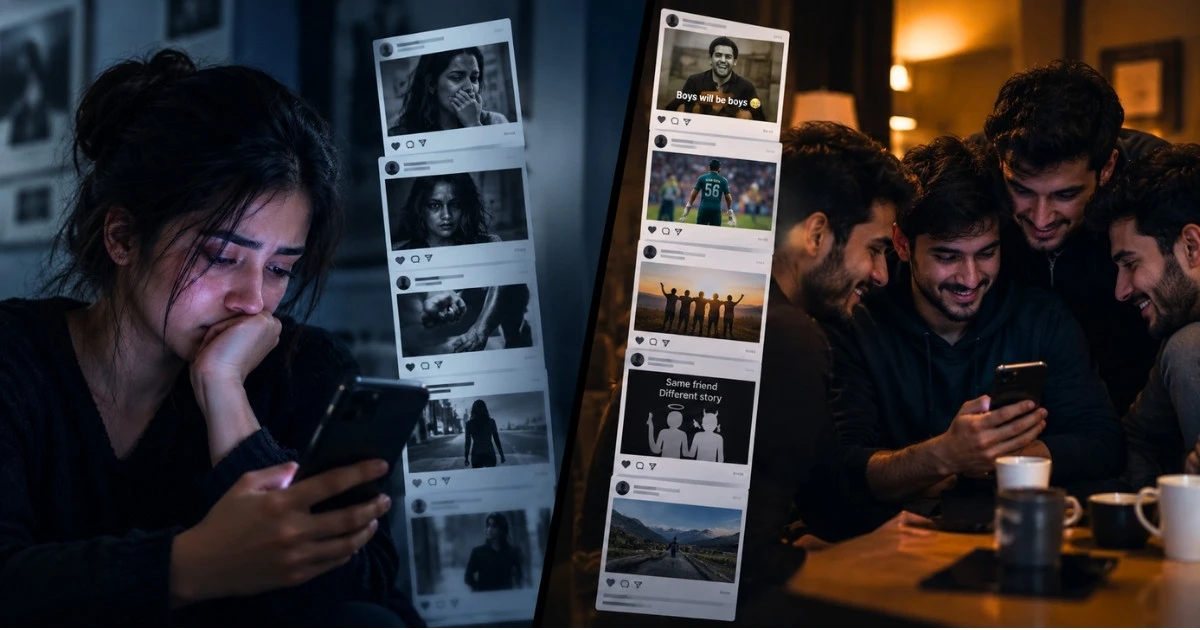
Mine has become an archive of women’s pain.
A woman raped. A girl killed for refusing a man. A wife beaten by the person with whom she shared a home. Jane Doe. Another Jane Doe. Another woman whose photograph I will look at for a few seconds before learning the manner in which a man decided her body belonged less to her than his anger, appetite, entitlement or amusement. But lately, it is not only the stories themselves that have unsettled me. It is their audience.
Beneath them, almost invariably, are women. Women sharing with women, grieving with women, raging with women. Women explaining coercion, consent and violence to other women who require none of the explanation. Women turning horror into language, language into awareness, awareness into another workshop, another campaign, another set of instructions for keeping ourselves alive. There is something so strange about this arrangement: so much of what men do to women appears to become a conversation women have among themselves.
Which is why, lately, I have wanted to look over at the other half of the internet. Men, what does your feed look like?
We ask whether men understand women when we should be studying the social arrangements that make understanding women unnecessary. A man need not believe rape is acceptable in principle if he knows that, in practice, his friends will rename it. Messy night. Mixed signals. Bad decision. Look what she was wearing. He was drunk. Complicated situation. Language arrives afterwards like a cleaning service. This is why I am less interested now in whether men can define consent than in the private ethics of male friendship.
Women have been asked endlessly what we would do to avoid violence. I want to know what men are prepared to do to make violence expensive for one another, not merely legally expensive, but socially expensive. Whether a man who humiliates women loses admiration. Whether the friend who ignores a no becomes difficult to remain friends with. Whether misogyny costs intimacy, belonging, invitations, reputation among other men, rather than merely attracting disapproval when a woman happens to be present.
Because culture is not ultimately what people condemn in public. Culture is what people permit one another to remain after the condemnation is over. I no longer want another conversation in which women become both the evidence of the problem and the unpaid faculty appointed to solve it.
So this is not another appeal to men to educate themselves. The material has been available for years. Women have testified until testimony itself has become a genre. We have supplied the vocabulary, the research, the laws, the campaigns, the personal stories, the public grief and, far too often, our own bodies as evidence.
We must educate men.
I have begun to find the phrase almost insulting.
There was a time when consciousness-raising meant giving language to experiences society had deliberately kept unnamed. But what exactly remains linguistically inaccessible here? Consent has entered law, policy, universities, workplaces, popular culture and the vocabulary of men themselves. A man can pronounce bodily autonomy perfectly and still feel entitled to a body.
Education can furnish a person with the language of justice without disturbing his relationship to power. Indeed, power has always been remarkably capable of learning the language used against it. Perhaps our mistake is imagining that every cruelty conceals a misunderstanding. It is a comforting liberal fantasy: if prejudice is ignorance, teach; if violence is ignorance, teach; if misogyny is ignorance, teach.
Eventually the workshop becomes almost theological, a faith that somewhere there exists a sufficiently persuasive PowerPoint after which domination will become embarrassed by its own illogic and quietly leave the room. But a boundary can be understood and still be crossed.
A woman can be recognised as fully human and still be treated as though, for one night, her humanity is negotiable. A Man can know. That possibility is considerably more frightening than ignorance because it deprives us of our favorite remedy. And perhaps this is where the conversation about men has remained strangely timid.
We ask whether men understand women when we should be studying the social arrangements that make understanding women unnecessary. A man need not believe rape is acceptable in principle if he knows that, in practice, his friends will rename it. Messy night. Mixed signals. Bad decision. Look what she was wearing. He was drunk. Complicated situation. Language arrives afterwards like a cleaning service. This is why I am less interested now in whether men can define consent than in the private ethics of male friendship.
Women have been asked endlessly what we would do to avoid violence. I want to know what men are prepared to do to make violence expensive for one another, not merely legally expensive, but socially expensive. Whether a man who humiliates women loses admiration. Whether the friend who ignores a no becomes difficult to remain friends with. Whether misogyny costs intimacy, belonging, invitations, reputation among other men, rather than merely attracting disapproval when a woman happens to be present.
Because culture is not ultimately what people condemn in public. Culture is what people permit one another to remain after the condemnation is over. I no longer want another conversation in which women become both the evidence of the problem and the unpaid faculty appointed to solve it. So this is not another appeal to men to educate themselves.
The material has been available for years. Women have testified until testimony itself has become a genre. We have supplied the vocabulary, the research, the laws, the campaigns, the personal stories, the public grief and, far too often, our own bodies as evidence.
Men, you do not need another woman to explain this to you.
Take the conversation somewhere we cannot take it for you. Take it into your friendships. Into the group chat after the women have left. Into the joke everyone understood but nobody challenged. Into the loyalty that becomes strangely sacred when one of your own is accused of harming a woman.
Take it to the friend whose behaviour women have learned to navigate while you continue enjoying the version of him reserved for men. Take it into every room where misogyny becomes less embarrassing because no woman is there to hear it.
And do not come back asking women how to make men better. Make cruelty cost something in the company of men. Make the humiliation of women disqualifying rather than amusing. Make the man who ignores a woman’s boundaries fear losing the respect of his male friends, not merely fear being exposed by her.
Make your friendship something a man can forfeit by what he does to women. Women have spent long enough changing our routes, our clothes, our language, our behaviour, our lives. Change yours. The next part of this conversation belongs in rooms full of men. Have it when we are not there.