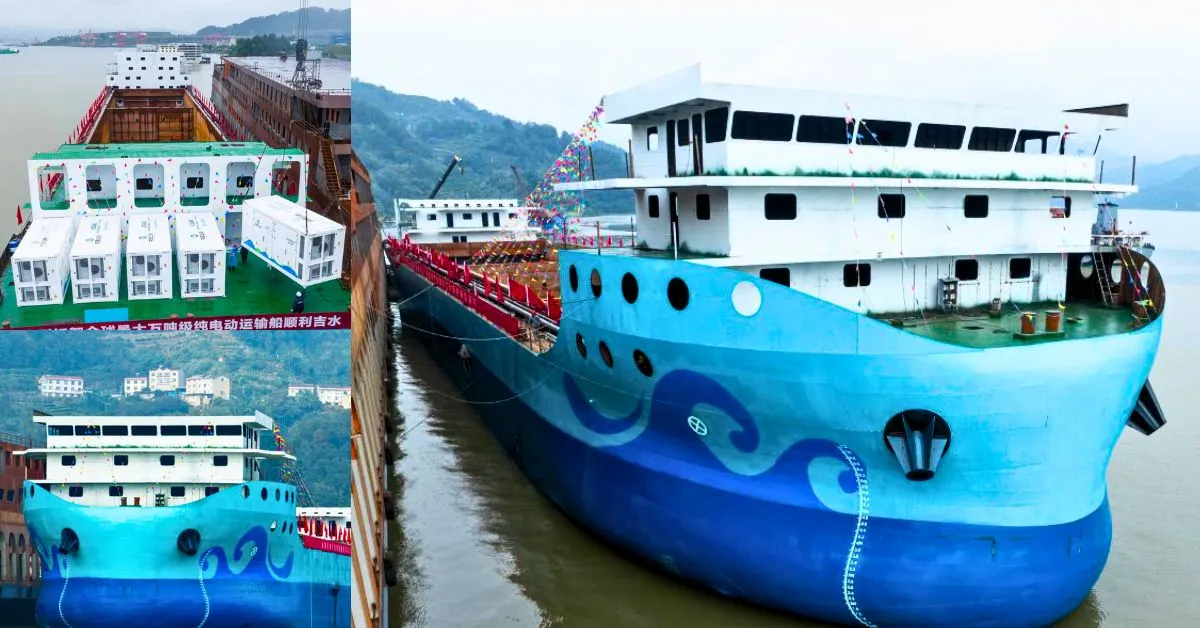
If you’re interested in technology, the environment, and future transportation, this news from China is sure to excite you. The world’s largest electric river cargo ship, named “Gezhouba,” has now launched.
This ship is not only enormous in size, but also a significant leap in concept, a vessel that runs entirely on electricity, consumes no diesel, and helps keep the environment clean.
On the morning of October 23, 2025, a grand ceremony took place in Yichang, Hubei Province, China. This is where the ship was launched near the world’s largest hydropower station, the Three Gorges Dam.
There was a special excitement at the launch of Gezhouba, as it is not just a ship but a symbol of China’s “Green Shipping Vision”, ships of the future that transport cargo without harming the environment.
Design and Size, A Giant Ship Floating on the River
The first thing that comes to mind when looking at Gezhouba is its size.
At approximately 130 meters long, the ship is larger than a football field. Its loading capacity exceeds 13,000 tons, meaning it can handle hundreds of trucks’ worth of cargo at a time.
The ship’s design is clean and robust; it was specifically designed for China’s major rivers, such as the Yangtze. The outer hull is made of steel, but it features an entirely new balancing system that ensures the ship remains stable and consumes less energy, even under heavy loads.
Batteries, not engines, are its heart.
The Gezhouba’s most significant feature is that it lacks a conventional engine. It runs entirely on lithium batteries.
The ship is equipped with 12 large lithium battery units, with a total capacity of approximately 24,000 kilowatt-hours (kWh). To put it simply, this is equivalent to the energy consumed by approximately 240 electric cars simultaneously.
With these batteries, the ship can travel approximately 500 kilometers on a single charge. This means it can cruise for several hours without stopping on rivers.
No charging, battery swapping, ready in just 30 minutes
Another interesting feature of the ship is its fast battery swapping technology. Unlike traditional electric vehicles, it doesn’t require hours of charging. Its batteries can be replaced at the port in just 30 minutes.
This is a significant advantage for a ship, as time is precious in river transport. This rapid battery-change technology enables Gezhouba to continue loading and unloading cargo without delay.
Smart Navigation System, Self-Propelled Vessel
Gezhouba is not just electric, it is also smart. It is equipped with an advanced intelligent control system that enables remote navigation (remote control) and automatic berthing (self-piloting).
This system features a multi-link communication network – meaning the ship is always connected to the port, weather station, and control center.
If river traffic is heavy or the weather changes suddenly, the system automatically adjusts its direction, speed, and route. This is what makes it an intelligent ship.
Significant Benefit to the Environment
Gezhouba’s most significant contribution is to the environment. Each year, this ship will save approximately 617 tons of fuel and reduce carbon dioxide emissions by over 2,000 tons. Salting this much carbon is equivalent to removing approximately 500 cars from the roads each year.
Because it lacks a diesel engine, this ship produces no smoke, noise, or oil leaks. This means that the water will remain clean, and so will the surrounding air.
A Fusion of Intelligence and Technology
Yan Xinping, a member of the Chinese Academy of Engineering, has called Gezhouba a “complete technological achievement.”
He says it’s not just a ship, but instead proves that China is now capable of integrating large battery technology, DC power systems, and remote piloting technology.
Yan, “Gezhouba has demonstrated that maritime transportation is no longer just a game of speed, but also of technical intelligence.”
How was Gezhouba built?
Building Gezhouba took years of hard work. Many of China’s leading shipbuilding engineering institutes worked on it.
The biggest challenge initially was safely installing such a large battery on the ship, as balancing the electrical system with water is a highly sensitive task.
Engineers designed a double-layer waterproof system on the ship’s underside, ensuring that even if a technical fault occurs, there would be no contact between electricity and water.
Digital monitoring sensors are installed on board the ship, continuously monitoring temperature, voltage, and battery health.
Speed and Performance
The Gezhouba’s maximum speed is approximately 20 kilometers per hour. This may sound low, but it’s a perfectly balanced speed for river transport, as stability and safety are of paramount importance for large cargo ships.
The ship is specifically designed for long-distance inland transport (river routes), such as the transport of coal, construction materials, or large industrial products from one port to another.
The exact cost of the Gezhouba has not been officially revealed, but it is estimated to have cost several hundred million yuan (approximately hundreds of crores of rupees) to build.
This is part of China’s Green Shipping Strategy, under which more ships will be built that run on renewable energy in the coming years. The government aims to have a significant portion of boats plying the country’s major rivers powered by electric or hybrid systems by 2030.
In simple terms, Gezhouba stands out for three main reasons: it is environmentally friendly, with no pollution or smoke; it uses innovative technology that enables independent docking and direction changes; and it offers low costs and high profits, as fuel savings and faster operations are advantageous for companies over time.
This will not only bring economic benefits to China but also strengthen its global image as a green technology leader.
The launch of Gezhouba is just the beginning. China is now working on more such all-electric ships. In the future, vessels running on hybrid power (using both batteries and solar) may also be introduced.
This initiative will not only keep China’s rivers clean but will also send a message to the world that sustainable shipping is no longer just a dream but is becoming a reality. Gezhouba is an example of how, if used correctly, technology can be a friend, not an enemy, of the environment.
When a ship sails down a river without emitting any fumes, it leaves behind only waves, no carbon, no noise. This is a scene that may become commonplace in the coming decades, when such quiet, electric vessels ply every river, restoring the balance between humans and nature.
Gezhouba is not just a technological triumph for China, but a direction for the entire world. It demonstrates that the key to future transportation is not just speed, but cleanliness and intelligence. The ship that sails smokelessly on the waves of the Yangtze today foreshadows the world of tomorrow, where both power and technology will live in harmony with nature.