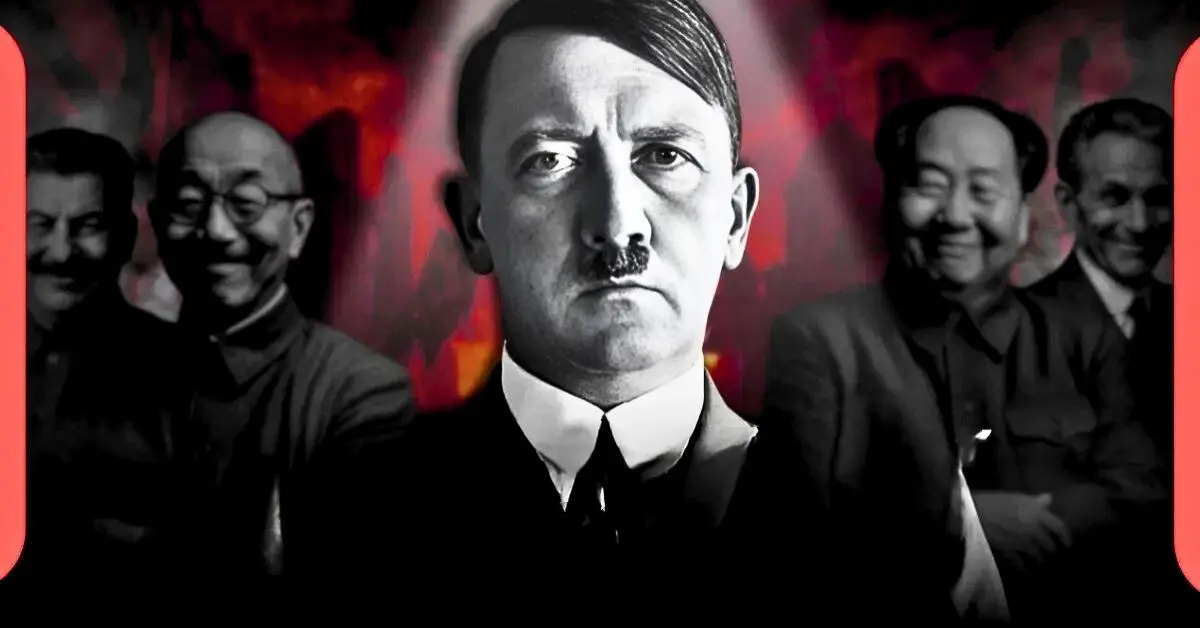
If you’ve grown up after World War II, one name has echoed through every history book, documentary, and movie: Adolf Hitler, the dictator whose very name became shorthand for evil. A man whose face, raised hand, and swastika banners still define humanity’s darkest hour.
But beneath the black-and-white footage and the thunderous speeches lies a question that history rarely asks: Was Hitler truly the sole embodiment of global evil, or was he shaped, amplified, and immortalized by the victors of war?
This story isn’t about defending a dictator. It’s about dissecting how power, propaganda, and politics can shape a man into a myth, a myth that has defined good and evil for generations.
The Rise of a Monster or a Mirror of His Time
Adolf Hitler was born on April 20, 1889, in Braunau am Inn, a small Austrian town on the German border. His father, Alois Hitler, was a strict customs officer, and his mother, Klara, was a gentle and deeply religious woman. Like many children of his era, Hitler grew up in a rigid home shaped by discipline, nationalism, and the lingering shadow of the Austro-Hungarian Empire.
As a teenager, he dreamed of becoming an artist. Twice, he applied to the Vienna Academy of Fine Arts and twice, he was rejected. Those rejections and his years of poverty in Vienna molded his bitterness. In the chaos of early 20th-century Europe, economic crises, anti-Semitic pamphlets, and the rise of nationalism, Hitler absorbed every poisonous idea around him.
When World War I erupted, Hitler found purpose. Serving as a soldier in the trenches of France, he witnessed destruction, camaraderie, and humiliation. Germany’s defeat in 1918 was sealed by the Treaty of Versailles, which left it and millions of others broken. The country lost territories, pride, and hope. Out of this humiliation, an ideology began to take shape: one that promised revival, revenge, and racial purity.
By the 1920s, the failed artist had become a fiery speaker, the man who once sold postcards now sold dreams of national rebirth. And by the early 1930s, with the help of industrial elites, conservative politicians, and a desperate population, Adolf Hitler, the outsider, became the Führer of Germany.
The Machinery of Hate
Hitler’s rise wasn’t built on charisma alone. It was a calculated product of fear, propaganda, and political manipulation.
Germany, reeling from hyperinflation and mass unemployment, needed a savior. The Nazi Party offered not reason, but emotion. Hitler’s speeches, amplified through radios and newspapers, blamed every crisis on enemies: the Jews, the communists, and the West. His minister of propaganda, Joseph Goebbels, mastered the art of repetition: “Tell a lie loud enough and long enough, and people will believe it.”
By 1933, the Nazis controlled Germany’s institutions. Civil liberties were stripped away. Dissent was silenced. Books were burned. And under the smokescreen of nationalism, systematic genocide was planned.
Concentration camps rose from the ground like factories of death. Six million Jews, along with Roma, Poles, disabled people, and political opponents, were exterminated in what became known as The Holocaust.
Hitler’s Germany was no longer just a nation but a cult-like civilization built on obedience, propaganda, and fear.
The War That Rewrote Morality
World War II began on September 1, 1939, with Germany’s invasion of Poland. It ended six years later with over 60 million dead soldiers, civilians, and children, all caught in a global storm.
Hitler’s armies ravaged Europe. France fell in weeks. London burned under air raids. The Soviet Union bled in Stalingrad’s snow. As his empire expanded, so did his delusion. The man who promised a thousand-year Reich collapsed into paranoia, isolated in his bunker beneath Berlin.
On April 30, 1945, Adolf Hitler took his own life. Germany lay in ruins, the world in mourning. And yet, as the smoke cleared, the story of the war was only beginning to be written.
The Victors Write History
History, they say, is written by the victors. After 1945, the Allied powers, the United States, Britain, and the Soviet Union, didn’t just rebuild the world. They built their narrative.
Hitler became the universal villain, the benchmark of evil. The Nuremberg Trials broadcast his crimes to the world, cementing his place in history’s darkest pages. But as the trials condemned Nazi leaders, few looked toward the crimes of the victors themselves.
The atomic bombings of Hiroshima and Nagasaki killed hundreds of thousands in moments. The firebombing of Dresden incinerated a city filled with civilians. Soviet soldiers committed widespread rape and looting across Eastern Europe. Yet these acts were explained away as “necessary military measures.”
Hitler’s horrors were undeniable, but the complete silence about the Allies’ own atrocities reveals something uncomfortable. Evil, it seems, is often defined by who wins.
When we think of genocide, one face comes to mind. But the 20th century was filled with others who rivaled and even surpassed Hitler’s death toll.
Mao Zedong’s Great Leap Forward and Cultural Revolution caused the deaths of tens of millions of Chinese citizens through starvation, torture, and purges. Joseph Stalin’s collectivization policies and Great Purge sent millions of Soviets to gulags or unmarked graves. Pol Pot’s Khmer Rouge turned Cambodia into a cemetery, killing a quarter of its population.
Yet, in popular culture, none of these figures carries the same symbolic weight as Hitler. There are no blockbuster movies about Mao’s famine or daily comparisons to Stalin in everyday language. Why?
Because Hitler’s crimes were recorded visually, viscerally, undeniably- cameras captured the liberation of concentration camps. Victims spoke in evidence-filled courtrooms. The Nazi regime left behind a trail of documentation so horrific that it became eternal.
Meanwhile, the atrocities of others remained hidden behind censorship, distance, and Cold War politics. To understand Hitler is not to excuse him. It is to know how democracies die and how despair becomes dictatorship.
After World War I, the Treaty of Versailles left Germany in economic and psychological ruin. Millions were unemployed, inflation made bread unaffordable, and national humiliation festered.
The Weimar Republic, Germany’s fragile democracy, was paralyzed by weak coalitions and endless political bickering. In this chaos, extremist voices grew louder. Conservative elites, thinking they could control Hitler, helped him seize power. They saw him as a temporary tool, not realizing they had unleashed a catastrophe.
Hitler was not born a monster. He was manufactured by fear, nationalism, and opportunism. He was the product of a broken system, a warning that even modern societies can fall prey to their insecurities.
Over time, Hitler evolved from a historical figure into a symbol, a shorthand for absolute evil. His name became a cultural archetype: the dictator in every story, the “Hitler” in every argument. But such mythmaking carries a danger. When one man becomes the singular symbol of evil, we risk ignoring the systems, ideologies, and ordinary people that made his crimes possible.
The Nuremberg Trials punished leaders, but the millions who followed orders, looked away, and benefited faded into anonymity. The lesson was simplified: Never be like Hitler. But the more profound message Never let your system create one was lost.
Anti-Semitism didn’t begin with Hitler. It had infected Europe for centuries, long before he was born. From medieval accusations that Jews “killed Christ,” to expulsions, pogroms, and conspiracy theories about Jewish wealth, hatred was woven into European history.
Hitler didn’t invent this prejudice; he exploited it. Nazi ideology took centuries of suspicion and molded it into policy. The Holocaust wasn’t just an act of hate; it was the culmination of history’s oldest bigotry. Every history is a balance between truth and power. The facts of Hitler’s crimes are undeniable, yet the way the world remembers them reveals how memory can be managed.
Hollywood, literature, and education turned Hitler into the “face of evil,” while quietly absolving others by omission. His defeat became the moral foundation of the modern world. The Allies’ narrative of heroism depended on his monstrosity.
It was easier to frame one man as the cause of chaos than to confront the truth: that global powers, economic greed, and propaganda combined to create the perfect storm for his rise. Adolf Hitler’s death in 1945 ended a war but began an era of reflection. For decades, his image has haunted humanity, a reminder of how ideology can eclipse empathy, and how collective silence can enable slaughter.
And yet, as new leaders rise worldwide, history seems to echo itself. Economic despair, populism, and disinformation, the same elements that birthed Hitler, are resurfacing. The lesson is not that Hitler was unique, but that his kind can return whenever societies stop questioning, whenever people trade freedom for fear.
Adolf Hitler was a dictator, a mass murderer, and the architect of humanity’s darkest chapter. His crimes cannot and must not be diluted. But to understand his singular place in history, we must also see the forces that elevated him, the victors who shaped his legend, the losers who bore his guilt, and the societies that chose silence over resistance.
The world needed a villain to define its morality. Hitler became that villain not just by his deeds but also by how the world remembered him. He remains the mirror in which humanity sees its capacity for hate, its thirst for power, and its dangerous tendency to forget.
In the end, Hitler was not just a man. He was a symptom of fear, failure, and the fragility of civilization itself.