When a film arrives carrying both the grandeur of history and the grit of modern crime, it naturally commands attention. In the Hand of Dante, directed by Julian Schnabel, is one such cinematic enigma, a film that spent decades in development before premiering at the Venice Film Festival in 2025.
With a cast that reads like a Hollywood hall of fame, Oscar Isaac, Al Pacino, John Malkovich, Gal Gadot, Gerard Butler, Jason Momoa, and even Martin Scorsese, this is not just a movie; it’s a fever dream about art, faith, and the eternal human hunger for meaning.
But the story of In the Hand of Dante begins long before its cameras rolled. It traces its origins to Niotches’s 2002 novel of the same name, a dark and poetic work that reimagined the quest for the original manuscript of Dante Alighieri’s legendary Divine Comedy.
Schnabel’s adaptation takes that premise and splits it into two timelines, one set in modern-day New York and the other in 14th-century Florence. Between these two worlds lies the haunting question: what price must one pay to touch divinity?
In the first timeline, we meet Nick Tosches (played by Oscar Isaac), a struggling writer in 21st-century New York. He is caught between the underworld of gangsters and his obsession with ancient literature.
When he stumbles upon what might be the original manuscript of The Divine Comedy, his life begins to spiral into fame, greed, and crime, all of which merge into a dangerous descent. Isaac portrays Nick as a man haunted by ambition, someone torn between sin and salvation, much like Dante himself.
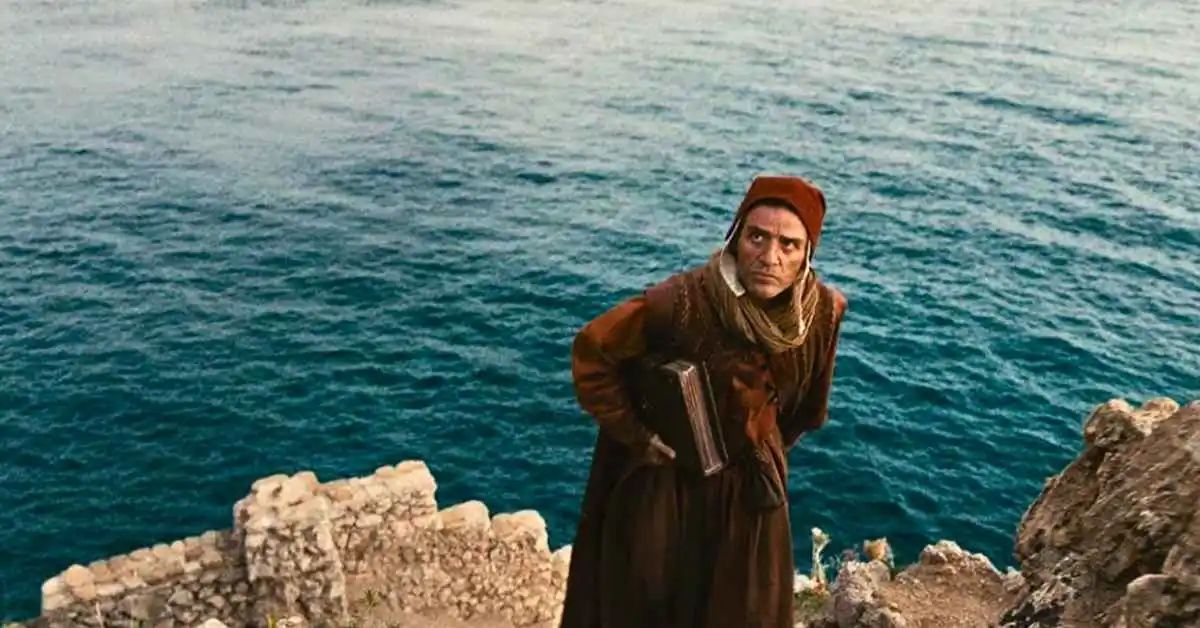
Then, the narrative shifts centuries back to Florence. Here, Oscar Isaac once again takes the stage, this time as Dante Alighieri, the exiled poet whose masterpiece reshaped the vision of Heaven and Hell. Schnabel’s decision to cast one actor to embody both Dante and Nick is not just a casting choice but a spiritual thesis. Through Isaac, the film draws a parallel between two souls separated by centuries but bound by the search for truth.
Isaac’s dual performance anchors the film. As Dante, he is fiery, visionary, and almost prophetic. Nick is fragile and lost, seduced by the promise of immortality. The contrast between these two faces of one man is where the Hand of Dante finds its poetry. Isadoesn’t just play his roles; he merges them into a single, living meditation on the creative spirit.
Gadot’s presence, too, carries the film’s emotional heartbeat. She plays two women across the two timelines: GemmDante’s beloved wife in medieval Florence, and GiuliettNick’s assistant-turned-lover in New York. In both forms, she represents the idea of divine love, tender, distant, and sometimes unreachable.
Her chemistry with Isaac is quietly magnetic. Whether as Gemma, praying under candlelight, or Giulietta, typing beside stacks of forbidden manuscripts, Gadot’s eyes carry the ache of devotion that transcends time.
Few films manage to gather this kind of ensemble. Al Pacino appears briefly but memorably as Nick’s uncle, a man who, in a flashback, gives him a piece of wisdom that becomes the film’s moral spin. “Some things,” he says, “aren’t meant to be found because they never were lost.” The line echoes through the story like a prayer.
John Malkovich, as a calm but chilling mafia boss, delivers menace through silence. Gerard Butler is terrifying as Louis, a hired assassin whose violence feels almost biblical. And in a delightful surprise, Martin Scorsese appears as an aging scholar, a spiritual guide who interprets Dante’s journey as the eternal human condition. Jason Momoa joins the chaos later as a new mafia leader, bringing an energy that jolts the film’s second half into motion.
Julian Schnabel, known for The Diving Bell and the Butterfly, brings a painter’s eye to filmmaking once again. He films the modern scenes in stark black and white, giving New York an austere, almost sacred feel as if sin itself had been drained of color. In contrast, the Florence sequences burst with gold, crimson, and deep shadows, like Renaissance paintings brought to life.
This visual contrast becomes the film’s soul: one world stripped of color and faith, the other alive with divine chaos. Schnabel’s camera lingers over the textures of ink, parchment, blood, and fire, as if every frame were a canvas about to catch fire.
The journey to bring In the Hand of Dante to life is almost as dramatic as the film itself. The project was first conceived nearly two decades ago. Johnny Depp had once been attached to star in and produce it, but over time the dream collapsed under the weight of delays, financing troubles, and, finally, the global pandemic. It was only after Oscar Isaac and Schnabel revived it that the film finally found its rhythm.
Even then, controversy followed. Both Gal Gadot and Gerard Butler faced political criticism that momentarily overshadowed the film’s debut. Yet when the lights dimmed at Venice, and the first scenes flickered across the screen, the noise faded. The audience witnessed a film that dared to merge theology and crime, poetry and blood.
At two and a half hours, the film demands patience. In the first hour, the New York storyline is sharp, intense, and filled with noir energy. When the story shifts to Florence, the pace slows, and the tone becomes meditative. Some viewers found this transition disorienting; others called it mesmerizing. Schnabel never chooses between crime thriller and philosophical parable; he lets both coexist, sometimes uneasily, sometimes beautifully.
The soundtrack, composed in quiet minimalism, mirrors the film’s duality, haunting Gregorian echoes fading into the hum of city streets. Every sound feels intentional, a heartbeat between centuries.
At its core, In the Hand of Dante is not just about a lost manuscript; it is about the longing that drives every artist, lover, and sinner. It asks: what happens when humanity tries to touch the divine? When does knowledge turn into obsession? When does faith turn into madness?
In Nieto’s search for Dante’s original words, the film sees a mirror of Dante’s own descent into Hell. Every temptation, Hellfaces, a gun, a kiss, a stolen page is a modern circle of the Inferno. And by the end, both timelines collide in a way that feels tragic yet inevitable.
OscIsaac’s double portrayal will likely be remembered as one of his most daring works. Al Pacino, in just a few minutes of screen time, leaves behind a ghost of wisdom. Malkovich and Butler are terrifyingly restrained, while Gadot radiates quiet strength. Even Scorsese, in his short role, brings a kind of serene gravity that binds the film’s spiritual undertones together.
After its premiere, In the Hand of Dante divided critics. Some called it an experimental masterpiece that dared to mix philosophy with pulp. Others found it too ambitious, too abstract for mainstream audiences. But whether one loved it or not, few could deny its power. The film became a talking point across film circles, academic discussions, and online communities.
In a cinematic landscape dominated by franchises and formula, In the Hand of Dante feels like a rebellion. It refuses to be just entertainment; it demands thought, reflection, and surrender. It’s a film that believes art can still provoke awe, that literature and cinema can still speak the language of the soul.
For Oscar Isaait, a performance that defines a career. For Schnabeit’st’s a culmination of years of artistic struggle. And for the audience, it’s an invitation to wander once more between heaven and hell hand in hand with Helle.
In the Hand of Dante is not a film for everyone, that’s precisely its beauty. It moves at its own rhythm, speaks its own language, and asks questions that echo long after the credits roll. It is about creation and corruption, about the cost of genius, and about the fragile line between art and sin.
For those willing to lose themselves in its world, the film offers more than a story; it provides an experience. An experience where OscIsaac’s haunting dualit, Schnabel’s painterly vision, and Tosches’s mystical prose merge into one living poem.
In the end, In the Hand of Dante is not merely watched, it is felt. It is a film that dares to believe, even in a cynical age, that art is still a sacred act.