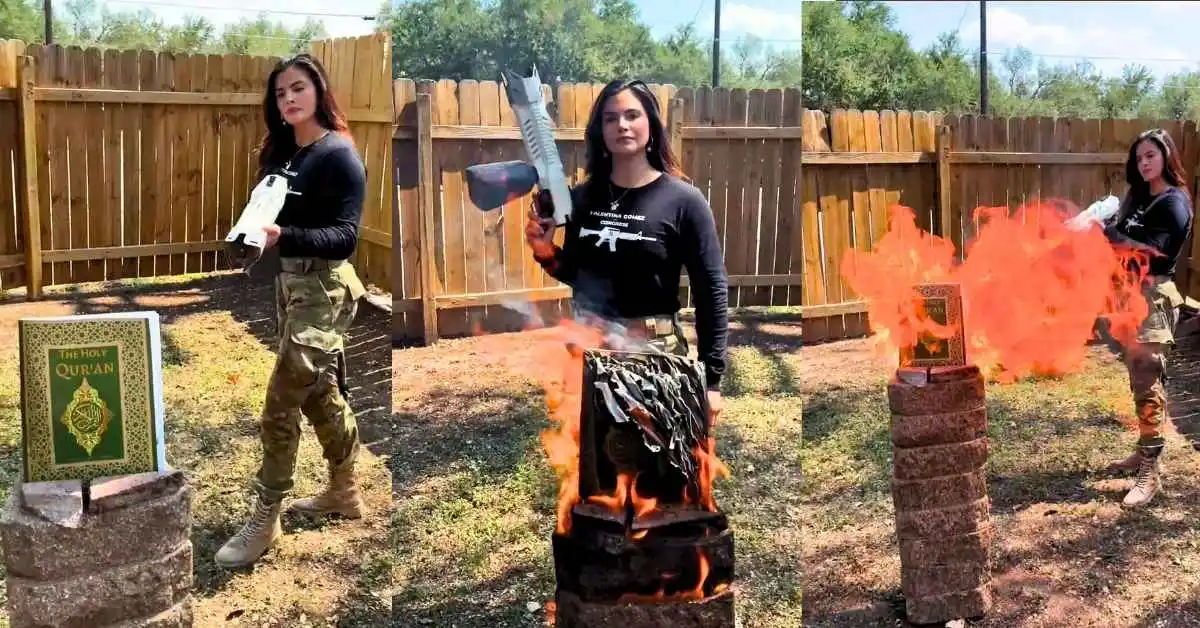
Texas | 26 August 2025: A recent act involving the alleged burning of the Holy Quran by Valentina Gomez, a controversial figure linked to the Texas Republican Party, has triggered widespread outrage and condemnation from Muslim communities, human rights groups, and members of the interfaith coalition across the United States and beyond.
The incident reportedly took place during a political gathering in a rural part of Texas, where Valentina Gomez allegedly set fire to a copy of the Holy Quran while making inflammatory statements against Islam. In a video circulated on social media platforms, she is heard vowing to “end Islam from the face of the Earth,” while criticizing what she calls “the Islamic threat to Christian nations.”
Public Backlash and Legal Responses
Following the video’s emergence, there was an immediate backlash online, with hashtags like #RespectQuran, #StopIslamophobia, and #ValentinaGomez trending across X (formerly Twitter), Instagram, and TikTok.
Several civil rights organizations, including the Council on American-Islamic Relations (CAIR), condemned the act and called for swift legal action against Gomez. “This is not just a hate crime against Muslims, it’s an attack on religious freedom and the core values of our Constitution,” said Nihad Awad, CAIR’s Executive Director.
Legal experts have pointed out that while freedom of speech is protected under the First Amendment, inciting violence or promoting religious hatred can fall under hate crime statutes, especially if such acts provoke unrest or target a specific group.
The local sheriff’s department has confirmed that an investigation is underway to verify the authenticity of the video and determine whether any state or federal laws were violated.
Political Silence and Divided Reactions
Interestingly, prominent members of the Texas Republican Party have so far remained largely silent on the issue. When contacted for comments, a party spokesperson stated: “We are aware of the video circulating online and are currently reviewing its contents before making any official statement.”
Some conservative voices have tried to frame the act as “free expression.” In contrast, others, including faith leaders and moderate Republicans, have distanced themselves from Gomez’s actions, calling them “un-American” and “deeply disturbing.”
In contrast, Democratic lawmakers and interfaith organizations have been more vocal. Texas State Senator Maria Castillo said in a press conference, “This is not about politics; this is about basic human decency. We must not allow hate to masquerade as patriotism.”
Muslim Community’s Response to Valentina Gomez Burning the Holly Quran in Texas
The Muslim American community, which makes up a significant and growing part of Texas’s population, has responded with both grief and unity. Vigils and peaceful protests have been held in Dallas, Houston, and Austin, with attendees calling for peace, justice, and greater religious tolerance.
“We will not let hate divide us,” said Imam Abdul Rahman from the Islamic Center of North Texas during a Friday sermon. “Our religion teaches peace, and we respond to hate with dignity, prayer, and lawful action.“
Several mosques have also stepped up efforts to educate the public about Islam, inviting non-Muslims to visit for interfaith dialogue events in the coming weeks.
Global Attention on Valentina Gomez Burn the Holly Quran in Texas
The incident has drawn global attention, with leaders and activists from countries including Pakistan, Turkey, Indonesia, and the UK expressing concern over the rising trend of Islamophobia in Western countries.
The Organization of Islamic Cooperation (OIC) has released a statement condemning the act and urging US authorities to take decisive action to prevent such provocations from escalating tensions.
This incident comes amid a rise in religiously motivated hate crimes across the United States, particularly targeting Muslim, Jewish, and immigrant communities. According to FBI statistics, hate crimes based on religion increased by over 30% in the past two years alone.
Analysts say that such provocative acts, especially when tied to political campaigns, can further polarise communities and weaken social cohesion.
Dr. Sarah Klein, a professor of Political Science at the University of Texas, noted, “Extremism on either side of the spectrum is dangerous. This event is a clear example of how political rhetoric can fuel religious hatred, which is not only morally wrong but politically destabilizing.”
As the investigation continues and public pressure mounts, the incident involving Valentina Gomez serves as a stark reminder of the dangers of unchecked hate speech and the importance of protecting religious harmony in a diverse society like the United States.
It remains to be seen whether Gomez will face any legal consequences, but what is clear is that the public is demanding accountability, not just from individuals, but from political parties and institutions that fail to condemn such acts unequivocally.
In moments like this, when anger and grief ripple through communities, it’s easy to forget that behind every act of hate, there are real people who bleed, pray, and hope just like everyone else. The burning of the Holy Quran in Texas was not just an attack on a book; it was an attack on millions of hearts that hold that book sacred. And for many Muslims living in America, it felt like a reminder that acceptance and equality are still promises that remain unfulfilled.
As the video of Valentina Gomez spread online, so did the heartbreak. You could feel it in the words of ordinary people: a father explaining to his children why someone would destroy something holy, a woman posting online that she hadn’t slept all night thinking about the disrespect, a student saying he felt unsafe walking to Friday prayers. These are not just reactions; they are emotional scars left behind by someone’s political stunt.
In Dallas, a small candlelight vigil brought together Muslims, Christians, Jews, and atheists, people who may never have met otherwise, standing shoulder to shoulder under a quiet night sky. They didn’t gather to protest; they gathered to heal. One young Christian woman held a sign that read, “My Bible teaches me to love, not to burn.” Another Muslim man said softly, “If she burned the Quran, let us light the world with kindness instead.”
Moments like that remind us that hate may shout, but love always answers softly and more powerfully.
Still, this incident cannot be brushed aside as “just another act of expression.” Freedom of speech should never be a weapon used to humiliate or divide. There’s a difference between expressing opinion and deliberately inflicting pain. The Quran burning was not an act of courage; it was a cry for attention built on ignorance. Real courage is found in understanding, not in setting fire to what others hold sacred.
Leaders, both political and religious, now face a moral test. Silence, in times like these, is not neutrality; it is complicity. Every elected official, every influencer who claims to stand for American values, must decide what kind of society they want to defend: one that tolerates hatred, or one that stands firm on empathy and respect.
Across Texas, something beautiful is quietly happening amid the anger. Mosques are opening their doors to visitors, inviting neighbors of all faiths to learn, to talk, to connect. In Houston, children at the Islamic school drew posters saying, “Love is stronger than hate.” In Austin, a pastor and an imam exchanged sermons in each other’s houses of worship. These gestures may not make headlines, but they are the real story the story of human resilience.
Globally, this act has stirred condemnation, but also compassion. From Pakistan to London to Jakarta, people are calling not just for punishment, but for understanding. They are asking for the world to learn that respect for religion is not weakness; finally, it is wisdom.
Valentina Gomez’s actions may have burned pages, but they also lit a conversation about who we are and what kind of humanity we want to pass on to the next generation. Maybe that’s the lesson buried beneath the ashes: that no flame, no matter how hateful, can extinguish faith, peace, or the shared hope that human decency will always rise again.
As America reflects, this moment must become more than outrage; it must become a turning point. Because if hate can spread with a match, then kindness must spread faster with a hand, a word, a bridge.