If you have seen Pakistan this year, you’ve seen a country quietly drowning not just in water, but in neglect, weak planning, and the weight of repeated tragedies. The floodwaters that swallowed parts of Khyber Pakhtunkhwa (KP) this monsoon didn’t just destroy homes; they exposed the old wounds of a nation that has long ignored its fragile foundations.
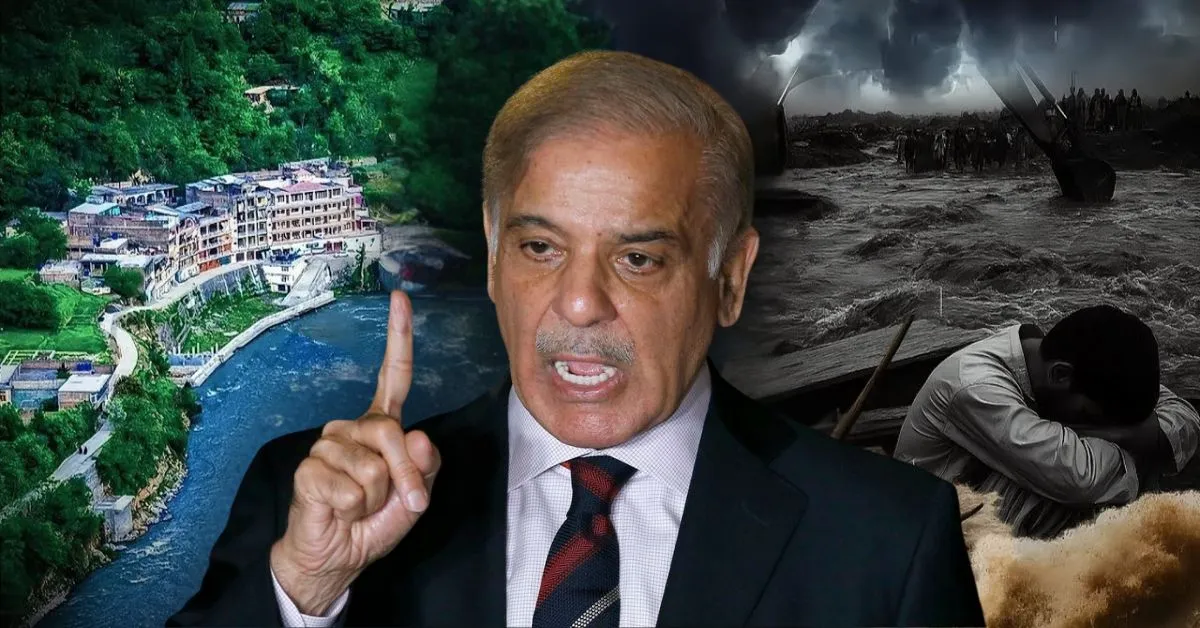
In the middle of this chaos, Prime Minister Shahbaz Sharif and Field Marshal Asim Munir arrived in the flood-hit valleys of Swat, Buner, and Shangla, two of the most powerful men in Pakistan, standing amid helplessness, mud, and broken bridges. Their visit was meant to bring hope, but it also symbolized how Pakistan once again found itself in a battle it had already fought and lost many times before.
Aerial Survey of Destruction: The Land That Once Sang
From the helicopter window, Swat no longer looked like the “Switzerland of the East.” The lush valleys that once hosted tourists and storytellers were now shades of brown and grey.
PM Shahbaz’s aerial survey over Buner and Shangla revealed a heart-wrenching sight: washed-out bridges, broken roads, and entire villages flattened by merciless currents.
The rivers that once nourished these communities had turned violent, carrying with them memories, livelihoods, and homes. It wasn’t just nature’s fury; it was a reflection of human negligence.
As the helicopter descended, Shahbaz Sharif stepped out into a crowd of desperate people. Their eyes carried pain and questions, but also a fragile hope that maybe this time someone would listen. Field Marshal Asim Munir, standing beside him in his military uniform, listened silently. Both men represented two institutions often blamed, yet always turned to, in times of national crisis.
“We Will Use Every Possible Resource” Words of Hope Amid Ruins
In Swat, PM Shahbaz distributed relief cheques to families who had lost everything, their homes, their fields, their loved ones. His words, though formal, struck a chord:
“This is a time of national crisis. We will use every possible resource to help the people.”
Behind him, Asim Munir met soldiers and rescue teams who had been working nonstop for days, pulling people out of collapsed houses and distributing food. The Pakistan Army had already airlifted tons of relief supplies to Gilgit-Baltistan and other northern areas. Helicopters had rescued stranded families from rooftops. Yet, as always, the question lingered: why does Pakistan only act after disaster strikes?
According to the Provincial Disaster Management Authority (PDMA), more than 385 people have died in KP alone, and over 180 women, children, farmers, shopkeepers, and entire families have been wiped away. In Buner district, more than 200 people have lost their lives. The numbers tell only part of the story; the real loss is measured in futures that will never return.
Nature’s Anger and Man’s Mistakes
When PM Shahbaz addressed the media, his tone was not just sorrowful; it was angry.
He admitted that the scale of destruction wasn’t only due to nature. It was artificial, built over years of illegal construction, unchecked mining, and deforestation.
Hotels built along riverbanks collapsed like paper. Roads constructed without planning were washed away in hours. The mountains that once stood tall had been weakened by greed, wood smuggling, sand mining, and unregulated tourism had stripped them bare.
“These floods,” the Prime Minister said, “are a warning from nature. We destroyed our own walls of protection.”
And he wasn’t wrong. Across KP, roughly 1,398 homes have been entirely or partially destroyed. Schools, hospitals, and small clinics are gone. In Swabi, a single landslide buried 41 people alive, their bodies found only after a four-day rescue mission. Across Pakistan, the death toll had already crossed 700.
Each monsoon, the same story repeats. Each time, promises are made. Each time, lessons are forgotten.
In moments of crisis, Pakistan’s military often becomes the backbone of response. Field Marshal Asim Munir walked through the mud, inspecting rescue operations and talking to soldiers. His words were brief but carried weight:
“No stone will be left unturned.”
He praised the troops working in extreme conditions, acknowledging their efforts as “service to humanity.” But even his calm authority couldn’t hide the frustration. Pakistan’s military can move mountains during a disaster, but without proper planning, it is always forced to act as the last line of defense rather than the first.
The army has long been accused of overshadowing civilian institutions, yet when tragedy hits, it is the army that leads the charge. This paradox, both the nation’s savior and symptom, continues to define Pakistan’s governance.
During the visit, PM Shahbaz announced a series of relief measures.
Free electricity for a week for flood-hit households. Immediate repair of damaged roads and bridges within seven days. Continuous supply of tents, medicines, and food. Compensation without delay.
The KP government, led by Chief Minister Ali Amin Gandapur, also stepped in approving an additional Rs 2 billion, bringing the total flood relief package to Rs 5 billion.
Hospitals were ordered to reopen immediately, mobile health units were to be deployed, and water supply systems were to be repaired. Cleanliness drives began to prevent post-flood diseases. Yet, even with all this effort, people in Swat, Shangla, and Buner know that once the cameras leave, the speed of relief slows down as it always has.
While relief work continues, the National Disaster Management Authority (NDMA) has issued another grim warning that a new system of heavy rainfall may hit Punjab and KP from August 23. Rivers are already swelling. Villages are already fragile. For many in Pakistan, the monsoon has become a season of mourning, a cycle of destruction that returns every year, stronger than before.
Climate Change and a Nation on the Edge
The more profound truth behind this disaster is climate change and Pakistan’s vulnerability to it. Despite contributing less than 1% to global carbon emissions, Pakistan remains among the ten most climate-affected countries in the world.
Rising temperatures are melting glaciers faster than ever. Rainfall patterns are changing. Urbanization without planning has made flood drainage impossible.
But climate change alone isn’t the villain. The real damage comes from Pakistan’s failure to plan, weak governance, and environmental ignorance. Forests continue to vanish. Rivers are choked by concrete. Development continues without discipline. Every year, officials promise “never again,” and yet “again” always arrives.
PM Shahbaz himself said:
“We can prevent such devastation in the future only by saving our forests and enforcing the law.”
It was a line that carried the weight of decades of unlearned lessons.
A Country That Needs Long-Term Vision
The tragedy in KP is not just about broken roads or lost houses, it’s about broken systems. Pakistan needs long-term climate resilience, not just temporary aid. Each flood should have been a turning point in 2010, 2022, and now 2025, yet the nation still lacks a proper urban drainage plan, reforestation policy, or strict zoning laws.
For decades, politicians have traded blame while ordinary citizens rebuilt their lives with their own hands. But water doesn’t wait for politics. It erases boundaries, exposes corruption, and reminds every government that nature is unforgiving to negligence.
In Buner, an older man stood in knee-deep water, holding a photograph of his son who didn’t survive. When asked what he expected from the government, he said quietly, “We don’t expect anything. We want them to remember us next year.” That single sentence captures the pain of millions of people who rebuild after every flood, only to see it all washed away again.
Pakistan’s struggle is no longer silent; it’s a cry that echoes from every broken home and every muddy street. Yet, amid this despair, there are glimmers of resilience: soldiers working day and night, volunteers risking their lives, and communities standing together despite everything.
The story of these floods is not just a story of destruction; it’s a mirror. A mirror showing Pakistan what it has become, and what it could still be if it learns to value its land as much as its politics.
For now, Swat, Buner, and Shangla wait for roads to reopen, for homes to rise, and for promises to mean something. The question is not whether Pakistan can rebuild. It always does.
The question is, will it finally learn?