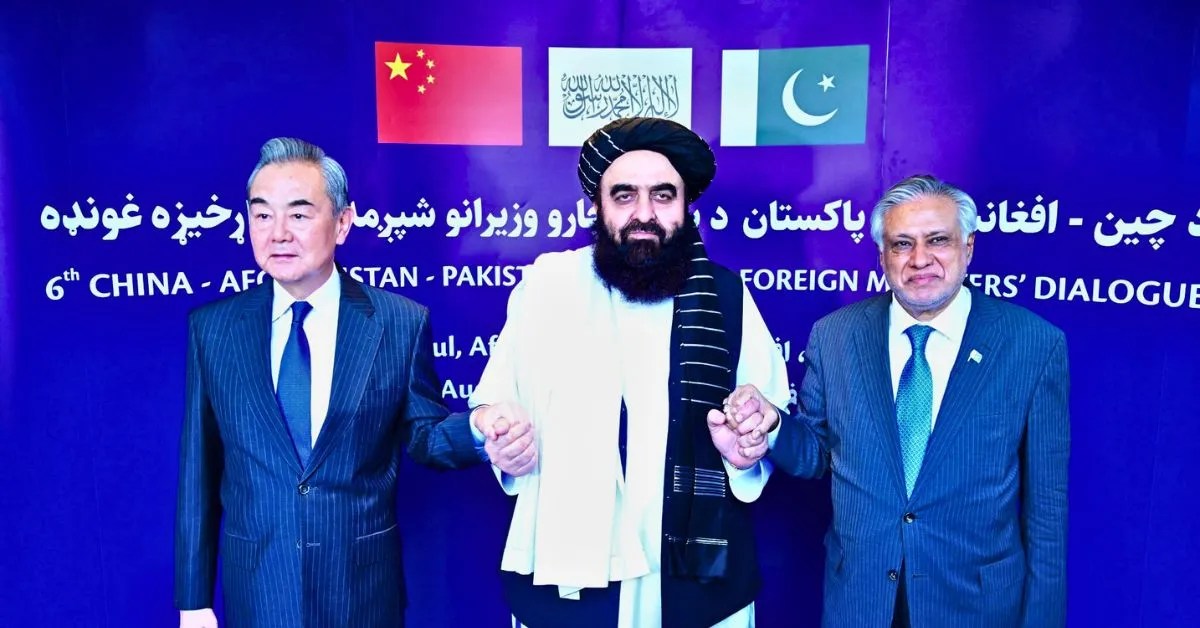
In a recent important meeting held in Kabul, Pakistan, China, and Afghanistan have promised to fight together against terrorism. This meeting took place during the sixth trilateral foreign ministers’ dialogue, attended by Pakistan’s Deputy Prime Minister and Foreign Minister Ishaq Dar, China’s Foreign Minister Wang Yi, and Afghanistan’s Acting Foreign Minister Amir Khan Muttaqi.
Purpose of the meeting
In this meeting, the three countries discussed collaboration on security and various other issues, including politics, economy, education, health, and trade. Mainly, emphasis was laid on stopping terrorism and drug trafficking. It was also decided that the China-Pakistan Economic Corridor (CPEC) would be extended to Afghanistan, which would benefit both regional connectivity and trade.
However, Ishaq Dar also expressed a big concern for Pakistan. He clearly said that there has been an increase in terrorist attacks in Pakistan for some time, and most of the attacks are being carried out through groups operating from Afghan soil.
Among these, the most frequently named were Tehreek-e-Taliban Pakistan (TTP) and Balochistan Liberation Army (BLA). Dar asked the Afghan government to take concrete and verifiable steps against these organizations.
Afghan Foreign Minister Muttaqi assured that Afghanistan’s land will not be used against any neighboring country. He also emphasized furthering the recently improved political and economic relations with Pakistan. Afghanistan also stated that most of the new agreements between the two countries have been completed or are nearing completion.
In this meeting, China played the role of mediator and worked to bring the three countries to one platform. China clearly says that terrorism is not just a problem of one country, but a threat to the whole world. This is why China wants to continue such dialogues. Also, China emphasized connecting Afghanistan as much as possible under the Belt and Road Initiative.
Reality of the situation
If we look at the ground situation, terrorist incidents in Pakistan have been increasing continuously since 2021. According to the July 2025 report, there were 82 attacks in the country in which 101 people died and 150 were injured.
The maximum impact of these incidents was seen in Khyber Pakhtunkhwa and Balochistan. Because of this, there is pressure on the government of Pakistan to work more strictly with Afghanistan.
One positive aspect of the meeting was that Pakistan and Afghanistan have further strengthened their diplomatic relations. Now, ambassador-level officers will work in both countries instead of Charge d’Affaires. This will speed up the process of dialogue and decision-making between the two countries.
It is clear from this meeting that Pakistan, China, and Afghanistan have understood that without eliminating terrorism, neither trade can grow nor can there be stability in the region. Pakistan hopes that Afghanistan will not only give assurances but will also take strict action against organizations like TTP and BLA. This is an opportunity for Afghanistan to show the world that its land is not being used for terrorism.
Overall, this meeting in Kabul is a positive step, but the real challenge now is to put these promises into practice. Pakistan has repeatedly said that it wants concrete evidence and not just words of assurance. If Afghanistan shows seriousness this time, a new era of peace and development can begin in the region.
The importance of this trilateral cooperation goes far beyond just counterterrorism. Experts believe that the success of this alliance will define the geopolitical future of South and Central Asia. Pakistan, China, and Afghanistan form a geographical triangle that connects the Middle East, Central Asia, and South Asia, three regions rich in energy resources and strategic trade routes.
Therefore, peace among these nations is not only essential for their internal stability but also for the smooth functioning of major economic projects such as CPEC and the Belt and Road Initiative (BRI).
China’s participation in the Kabul dialogue is particularly noteworthy. Beijing has been trying to ensure that instability in Afghanistan does not spill over into its Xinjiang region, where it faces its own internal security challenges.
China has invested heavily in infrastructure and mining projects in Afghanistan, and it sees long-term peace as vital for the protection of its economic interests. Analysts say that if China can succeed in balancing relations between Islamabad and Kabul, it would be a significant diplomatic victory for Beijing in South Asia.
For Pakistan, this meeting is a test of both diplomacy and national security. Since the withdrawal of US troops from Afghanistan in 2021, Islamabad’s border areas have once again become vulnerable to attacks.
Groups such as TTP have taken advantage of the power vacuum in Afghanistan, finding safe havens and launching cross-border operations. Islamabad has repeatedly demanded that the Taliban government take action, but so far, results have been limited. This trilateral framework could now serve as a formal mechanism for holding all parties accountable.
Afghanistan, on the other hand, faces its own set of challenges. Since the Taliban took power, the country has been diplomatically isolated and economically crippled. The new rulers are eager to gain recognition and legitimacy on the international stage.
Cooperation with China and Pakistan provides a rare opportunity to improve Afghanistan’s image. If Kabul can show tangible efforts to curb terrorism, it may open the door to more foreign investment and humanitarian aid.
Economic connectivity was another central point in the Kabul dialogue. The proposal to extend CPEC into Afghanistan could transform the region’s trade dynamics. This would allow Afghanistan to access major ports like Gwadar and Karachi, giving it a direct route to the Arabian Sea.
In return, Pakistan would gain access to Central Asian markets through Afghan transit routes. China’s interest lies in creating a stable trade corridor that links its western regions to Europe through Afghanistan and Pakistan.
Still, many challenges lie ahead. Political trust remains fragile between Pakistan and Afghanistan, with both sides accusing each other of harboring militants. Additionally, Western powers remain skeptical about China’s growing influence in the region, which could complicate future negotiations. Yet, despite these hurdles, the fact that all three countries came together for dialogue marks a significant diplomatic achievement.
The Kabul trilateral meeting represents both a hope and a test for the region. If the promises made are implemented sincerely, this cooperation could reshape South Asia’s security and economic future.
But if words fail to translate into action, the same old cycle of mistrust, violence, and missed opportunities will continue. For now, all eyes are on Kabul, Islamabad, and Beijing to see whether this new alliance truly becomes a turning point toward lasting peace and prosperity in the region.